
Signal and Noise: What to Track Between DEXA Scans
A field guide to reading your body composition data between scans.

Where the data begins.
The trouble with measuring your body is that the most convenient number is often the least useful.
Most people starting a body recomposition program, the practice of gaining muscle while losing fat, fixate on the scale. But if you’re doing it right, the scale shouldn't move. You are essentially trying to replace a pound of lead with a pound of feathers. The weight is the same, but the density is different.
To solve this, people turn to DEXA scans. They are the closest thing to ground truth in body composition. But you can’t get a DEXA every Tuesday; it’s expensive and inconvenient, which leaves a six-month gap between data points. This is where people get lost. They need a compass to stay on track, and that’s usually where BIA (Bioelectrical Impedance Analysis) scales and smart tape measures come in.
The Signal and the Noise
The first thing to understand about a BIA scale, even a high-end one, is that it isn't actually measuring your fat. It’s measuring how well your body conducts a tiny electrical current.
Muscle is mostly water; it’s a good conductor. Fat is an insulator. The scale sees how much resistance your body offers and then makes a guess about your composition. The problem is that your body's "conductivity" changes every time you drink water, eat salt, or break a sweat.
If you have a BMI of 23, technically healthy but perhaps carrying more fat than you’d like, the "signal" you’re looking for is very small. You might only be losing 0.1% of body fat a week. But the "noise" from your hydration levels can swing by 1% or 2% in a single morning.
Statistically, a single BIA reading is almost worthless. It’s a blurry photo taken from a moving car.
But if you step on that scale every morning at the same time, you can start to calculate a seven-day rolling average. Does that average going down mean you’re losing fat? Not necessarily. It might just mean you’re slightly more dehydrated this week than last. However, if the thirty-day trend is pointing down while your strength in the gym is going up, that combination is associated with genuine recomposition.
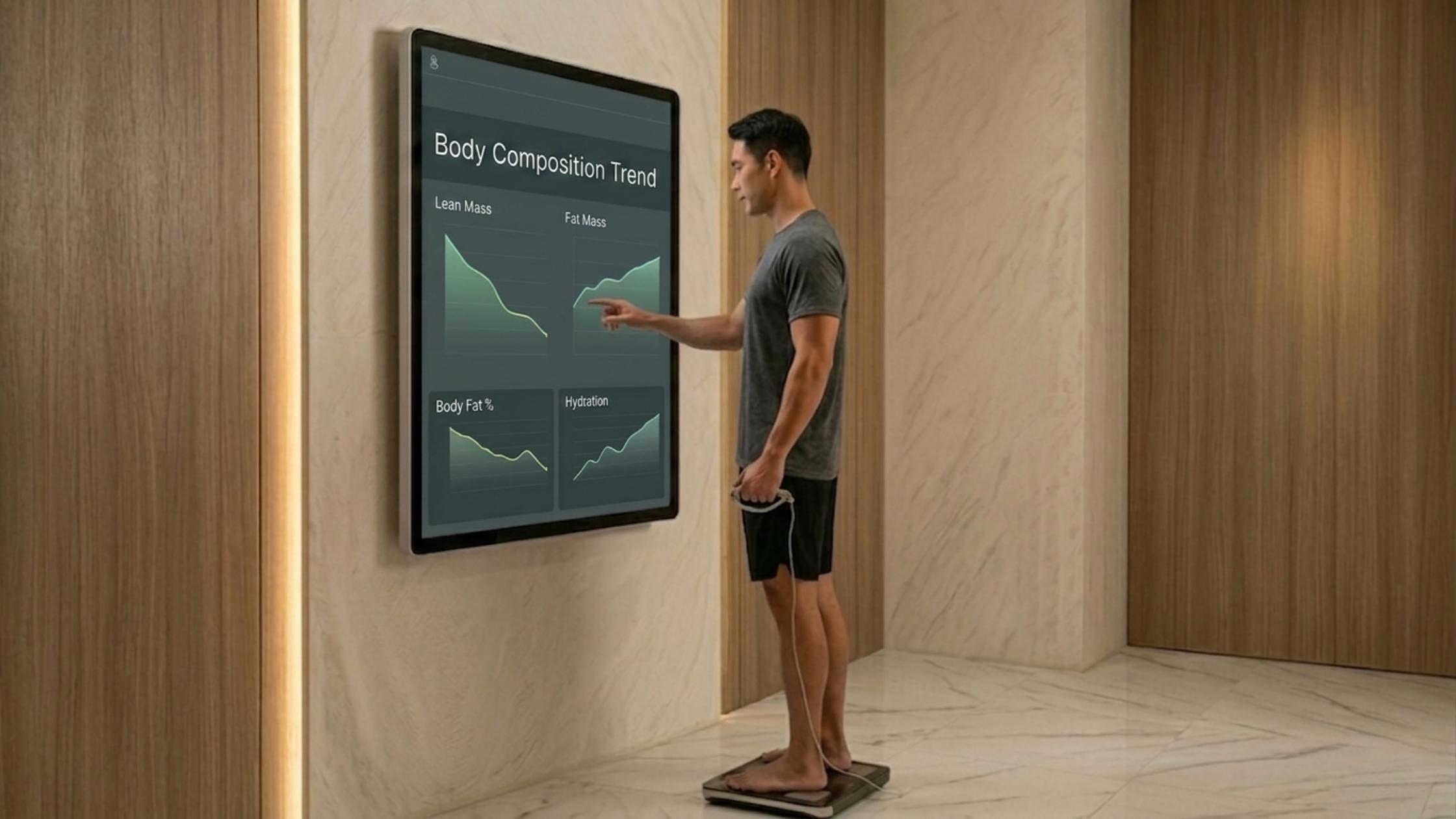
A single reading rarely tells the truth. The trend, over weeks, usually does.
Geometry vs. Electricity
If BIA is an electrical inference, a waist measurement is a physical reality.
Muscle is roughly 20% denser than fat. If your weight is stable but your waist is shrinking, you are, by the laws of physics, undergoing recomposition. There is no other way for those two things to be true at the same time.
A smart tape measure is "better" than a BIA scale in terms of validation, but it’s worse in terms of friction. It’s cumbersome. You have to find the right spot on your iliac crest, make sure the tape is level, and try not to subconsciously suck in your gut.
Because of this friction, most people won't do it every day. And that’s actually a feature, not a bug. By measuring once a week, you're naturally filtering out the daily noise of "gut fill" and bloating. You get a high-fidelity data point that confirms what the noisy BIA scale is trying to whisper.
The Adherence Anchor
The real value of these tools isn't scientific accuracy; it’s psychological adherence.
In startups, we have a saying: "What gets measured, gets managed." The act of stepping on a scale or wrapping a tape around your waist is an "Adherence Anchor." It’s a daily ritual that reinforces your identity. It reminds you that you are the kind of person who cares about this goal.
The danger, of course, is the "Negative Feedback Loop." If you’re a BMI 23 individual working hard, and the BIA scale tells you you’re "fatter" on Tuesday because you had a salty dinner on Monday, it’s easy to get discouraged. You have to learn to treat the scale like a buggy beta version of a software tool: interesting to look at, but not something to make decisions on.

The scan is the anchor. The discipline lives in the months between.
Does the Scale Matter?
People often ask if the specific brand of BIA scale matters. Does a $500 Hume Pod give you a better "truth" than a $30 Amazon scale?
Technically, yes. A scale with hand sensors (8 electrodes) is more precise because it actually measures your torso and arms, whereas foot-only scales just "guess" what’s happening above your waist.
But in the long run, the hardware matters less than the habit. A slightly inaccurate tool used consistently is infinitely more valuable than a "perfect" tool that sits in the closet because it’s too hard to use.
The Strategy
The best way to evaluate progress between DEXA scans is to use a hierarchy of data:
The Daily BIA: Use it as a behavior trigger, but ignore any single day's data.
The Weekly Waist Measure: Use it to validate the trend. If the waist is shrinking, the program is working.
The Monthly Trend: Look at the 30-day slope of your BIA readings. If it’s trending down, you’re on the right path.
The goal isn't to have perfect data. The goal is to have just enough signal to keep you from quitting before the six-month DEXA can prove you were right all along.
This is the data discipline our physicians apply across every pillar at Elyx. Every signal to act on, not so much that the noise drowns out the signal.
One interesting thing to consider: does having too much data actually make us more likely to quit? Or does the data itself act as a kind of "sunk cost" that keeps us committed to the program?
Elyx is Singapore’s first concierge healthspan service, based at the Raffles Hotel Arcade. To learn more about memberships, enquire here.
